What People Mean by "Health Supplements" in Singapore
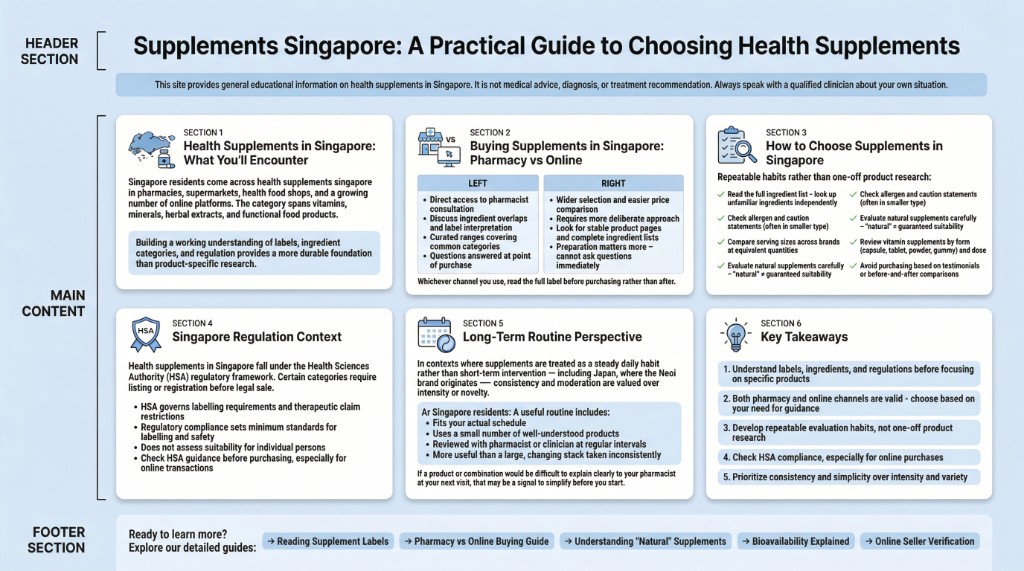
The term health supplements singapore residents encounter most often covers a broad and loosely defined product category. It typically includes vitamins and minerals, amino acids, herbal and botanical extracts, probiotics, collagen products, and plant-derived concentrates. These examples are listed to illustrate the range of the category — not as recommendations of any specific type.
Vitamin supplements singapore products range from single-nutrient formats (a standalone vitamin D capsule, for example) to multi-ingredient formulas combining several nutrients in one serving. Probiotic and collagen products are among the most widely searched categories online in Singapore. Understanding that these are distinct categories with different ingredient structures, label conventions, and regulatory treatments helps when reading and comparing products across types.
The key distinction worth keeping in mind is between supplements and medicines. In Singapore, health products that make therapeutic claims — treating or preventing a named condition — require a different regulatory pathway from general supplements. A product positioned as a supplement should not carry treatment claims on its label.
Where to Buy Supplements in Singapore: Pharmacy vs Online
There are two main channels for buying supplements in Singapore: licensed pharmacy retailers and online platforms.
Pharmacy supplements singapore options are stocked under pharmacist oversight. A pharmacist can help you read an ingredient list, identify potential overlaps with other products you take, and clarify label terminology. The range is typically curated and changes less frequently than online listings, which makes comparison more straightforward within the category.
For supplements singapore online purchases, the selection is wider and price comparison is easier. The trade-off is that you cannot ask questions at the point of purchase, and seller quality varies significantly across platforms. When you buy supplements singapore online, prioritise sellers who provide complete ingredient lists, readable label images, stable product pages, and clear contact or importer details. Avoid listings with vague descriptions, exaggerated outcome language, or no verifiable seller background.
Both channels involve the same label-reading discipline. The channel choice affects convenience and access, not the standard of care you apply when evaluating what you are purchasing.
How to Compare Supplement Labels
Reading supplement labels singapore products carry is a learnable skill. The following approach applies regardless of product type or purchase channel.
Ingredient list first. Identify every active ingredient by name. Look up any ingredient you do not recognise before purchasing. The order of ingredients (typically by quantity, descending) gives a rough sense of what is primary in the formula.
Serving size and units. Check what one serving is, then compare across products using the same unit and serving amount. A product listing 500 mg per two capsules provides the same amount per serving as one listing 250 mg per capsule — the headline number alone is not sufficient for comparison.
Overlapping nutrients. If you take more than one product, add up each nutrient across all products you are taking. Multi-ingredient formulas often overlap with single-nutrient supplements. A pharmacist or clinician can review your full intake list if you are uncertain about the total.
Caution and allergen statements. These appear in smaller type but are relevant for many people and should not be skipped.
A note on "natural": the descriptor natural supplements singapore products often carry is a marketing term with no standardised legal definition. Evaluate products by their full ingredient list, not the label category.
Regulation Context in Singapore
Supplements regulation singapore falls under the Health Sciences Authority (HSA). The HSA oversees labelling requirements, restricts certain therapeutic claim types, and — for some product categories — requires listing or registration before products can be legally sold.
This framework sets a minimum baseline. It governs what can be claimed, how products must be labelled, and what safety standards apply at a category level. It does not assess whether any individual product is suitable for a specific person, and regulatory compliance is not a substitute for your own label review or clinician input.
When purchasing online, checking whether a seller and product are consistent with current HSA guidance is a practical step. Sellers with no verifiable importer information or products with unlabelled ingredients are worth treating with caution regardless of platform.